
Strait of Hormuz Blockade Pushes Crude Prices Beyond $100, Shaking World Economies
The escalating war between Iran, the U.S., and Israel has triggered a global oil emergency, with prices surging past $100 per barrel and supply chains through the Strait of Hormuz nearly paralyzed. India, China, Europe, and other oil-dependent economies face immediate economic shocks, while experts warn of prolonged volatility unless coordinated solutions are adopted.
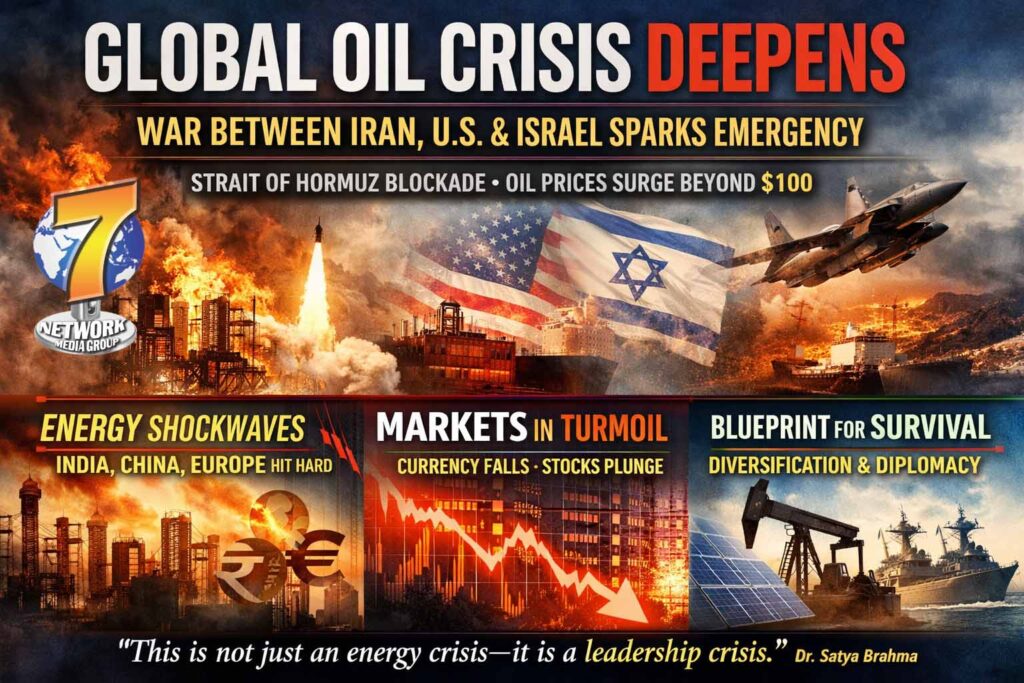
The Global Oil Emergency
- Conflict Trigger: Joint U.S.-Israeli strikes on Iran have targeted nuclear facilities and military infrastructure, prompting Iranian retaliation against Gulf oil and gas facilities.
- Strait of Hormuz Blockade: Iran’s threats and attacks have disrupted maritime traffic, halting oil and LNG exports from one of the world’s most critical chokepoints.
- Price Surge: Brent crude has spiked above $92–100 per barrel, marking a 28% weekly increase and the highest levels since 2022.
India, China, Europe Face Energy Shockwaves
Import-dependent nations brace for inflation, supply chain disruption, and political unrest
Markets in Turmoil as Energy Costs Soar
Stock indices tumble, currencies weaken, and industries struggle under fuel inflation
Blueprint for Survival: Diversification & Diplomacy
Experts call for renewable acceleration, strategic reserves, and urgent UN-led negotiations
Countries Most Affected
| Region/Country | Impact | Key Risks |
| India | Faces immediate energy security challenges; oil import costs rising sharply | Currency depreciation, inflation, trade route instability |
| China | Heavy reliance on Gulf oil imports | Manufacturing slowdown, higher export costs |
| European Union | Dependent on Middle Eastern oil & LNG | Energy inflation, industrial disruption |
| Japan & South Korea | Import-dependent economies | Rising electricity and transport costs |
| U.S. & Israel | Military expenditure and domestic fuel inflation | Political backlash, economic strain |
Economic Fallout
- Equity & Currency Volatility: Stock markets in Asia and Europe are under pressure, with oil-sensitive sectors (aviation, transport, manufacturing) hit hardest.
- Inflationary Shock: Rising fuel costs are feeding into food and commodity prices globally.
- Supply Chain Disruption: LNG exports from Qatar and oil shipments from Saudi Arabia face delays, worsening shortages.
Blueprint for Solutions
- Diversification of Energy Sources
- Accelerate renewable energy adoption (solar, wind, nuclear) to reduce dependence on Gulf oil.
- Expand domestic oil and gas exploration in India, China, and Africa.
- Strategic Reserves & Alliances
- Countries should release oil from strategic petroleum reserves to stabilize markets.
- Strengthen regional alliances (India-Japan-Australia energy corridor) to secure alternative supply chains.
- Maritime Security & Diplomacy
- International naval cooperation to secure the Strait of Hormuz and protect shipping lanes.
- Push for urgent UN-led negotiations to prevent escalation and reopen trade routes.
- Economic Cushioning
- Subsidies for critical sectors (transport, agriculture) to absorb fuel shocks.
- Currency stabilization measures to counter inflationary pressures.
Outlook
Unless the war de-escalates, the oil crisis could evolve into a prolonged global recession, with developing economies like India bearing the brunt. The blueprint lies in energy diversification, strategic reserves, and coordinated diplomacy—a test of whether global leadership can act decisively in the face of disruption.
“This oil emergency is not just an energy crisis—it is a leadership crisis. Nations must rise above narrow conflicts and embrace collective responsibility. The blueprint lies in diversification, diplomacy, and decisive action.” Says Dr. Satya Brahma, Chairman & Editor-in-Chief, Network 7 Media Group